Imagine a couple telling their advisor they want to retire in five years. They agree on a savings target. They both want more time together. The meeting seems to have a clear direction.
Then the advisor asks where they picture spending that time.
One imagines several months abroad each year. The other wants to move closer to their adult children and be around for ordinary family life. This is a hypothetical example, but it exposes a planning problem. The same retirement date and savings target can describe very different futures.
Before those expectations become assumptions in a financial plan, both people need a chance to explain them. Otherwise, a careful calculation can answer a question the couple has not actually settled.
There is evidence for looking beneath broad agreement. Ameriprise Financial's 2024 report described 93% of surveyed couples as sharing retirement goals. Separately, it reported that 25% of those surveyed disagreed about how much to spend on experiences, travel and hobbies. The research covered 1,510 U.S. couples with at least US$100,000 in investable assets. Primary respondents were aged 45 to 70 and had retired in the past ten years or planned to retire in the next ten. It describes that selected group, not every household.1
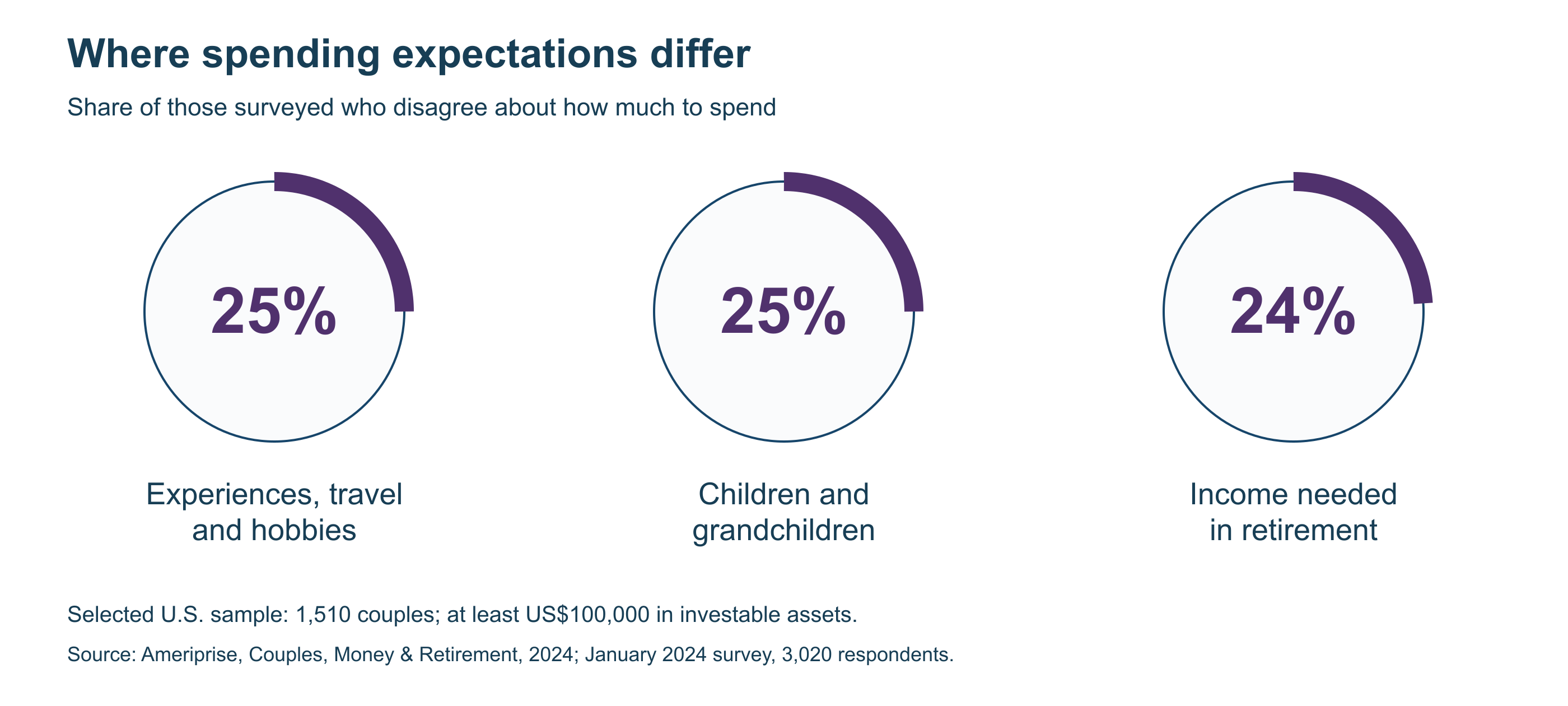
Separate survey findings, not mutually exclusive categories. Primary respondents were aged 45 to 70 and within ten years before or after retirement. See the Ameriprise report for methodology.1
Fidelity's 2026 Couples & Money study adds another reason to ask. It reported that 69% of respondents were not regularly discussing long-term finances. The survey involved 3,193 married or partnered U.S. adults, with fieldwork in late 2025. That is a measure of reported conversation frequency, not proof that those relationships have a problem.2
For an advisor, the useful question is specific: what does each person expect the plan to make possible?
Ask what an ordinary week would look like
Before starting, confirm that each person wants to participate, who is a client and who may give instructions. Establish what information each person has authorized you to share. Explain how separate conversations and their records will be handled, including limits on confidentiality. Do not infer permission to disclose from attendance at a joint meeting.3 Agreement about a goal does not authorize an account change or transfer.
Start with the life behind the target. A phrase such as "more freedom" leaves a lot to interpret. It might mean leaving a demanding job, spending more time with family or being able to travel without checking a work calendar.
Give each partner room to answer the same question before combining their responses. "What would you like an ordinary week to look like five years from now?" invites more detail than asking whether both people feel good about retirement.
Follow the answer far enough to understand it. How much time away would feel right? Which relationships need regular, in-person contact? Does either person want to keep working? What would they be disappointed to give up?
A 2021 study of 118 older couples in greater Vancouver illustrates a narrower point about everyday goals. Each person listed three important goals for the coming week and identified which they considered joint. Independent comparisons of the partners' lists did not always match those descriptions. A goal missing from a partner's list did not necessarily mean that partner opposed it. The study concerned short-term goals, so it cannot establish how often couples disagree about retirement.4
That distinction matters in a meeting. A different answer is a reason to ask another question. It is too little evidence to diagnose conflict.
The advisor can then summarize each person's account and ask them to correct it. "You want the flexibility to spend longer periods away. You want a home base close enough to see family during the week. Have I understood both of you?"
There are limits to this conversation. If someone appears afraid to disagree or raises concerns about coercion or control, pause the effort to reach a joint decision. Do not press for disclosure in front of the other partner or assume a shared follow-up is safe. Follow the firm's safeguarding and escalation procedures for sensitive records and specialist support. Stay within your competence rather than trying to mediate or provide relationship therapy.
Find the decision inside the disagreement
The travel-and-family example sounds like a choice between two incompatible lives. On closer inspection, it contains several separate decisions.
Does the couple need to move? How long would each trip last? Must they travel together every time? Does being near family mean living on the same street or within a reasonable journey?
Those details determine what needs to be compared. An advisor might organize the hypothetical conversation like this:
| Decision | One partner's stated preference | The other's stated preference | What remains open |
|---|---|---|---|
| Home base | Not yet specified | Live closer to adult children | Whether, where and when to move |
| Time away | Several months abroad each year | Be nearby for ordinary family life | Trip length, frequency and whether all travel is together |
| Retirement timing | Retire in five years | Retire in five years | Whether both mean stopping all paid work |
These are illustrative preferences, not survey findings or recommendations. The table does not settle the choices. It stops a broad phrase such as "enjoy retirement" from hiding them.
Some differences concern an outcome. Others concern how to get there. Both partners may want strong family relationships while disagreeing about whether proximity is necessary. They may both value travel while wanting different amounts of it.
Ask what makes each preference important before discussing what could change. The answer may reveal an option neither person had described, or confirm that a genuine trade-off remains.
Compare the choices before choosing a compromise
Once the decisions are clear, financial analysis has a defined job. It can examine the consequences of the options the couple actually wants to consider.
For the hypothetical couple, that might mean comparing a move followed by shorter trips with keeping their present home and taking longer trips. Each scenario needs explicit assumptions about timing, housing costs and spending. The advisor should distinguish information supplied by the clients from estimates that still need checking.
Keep personal preferences separate from practical constraints. Wanting to stop work on a certain date is a preference. A known employment commitment or current household expense is a different kind of input. Neither should quietly disappear because a scenario would look simpler without it.
The discussion can then become more precise. Which cost needs better evidence? Which choice can wait? What would make either partner reconsider? Is a proposed arrangement temporary, or does one person imagine it lasting indefinitely?
A midpoint is not automatically a satisfying compromise. Six weeks away could still feel too long to one person and too short to the other. A calculation can show the financial implications of six weeks. It cannot establish that both people want them.
Separate retirement dates deserve the same attention. Ask what daily life would look like while one person works and the other does not. Travel plans, household routines and expectations about time together need to fit that period too.
None of this requires the advisor to decide whose priorities are better. The point is to give the couple enough concrete information to make a decision, while preserving uncertainty where the information is incomplete.
Leave room for goals that belong to one person
A household plan can include goals that only one partner wants to pursue. A course, a business project or a trip with friends need not become a joint ambition to deserve discussion.
Financial independence also deserves a direct question. In Fidelity's study, 66% of respondents said it was important. That finding does not prescribe a particular account arrangement, but it is a reason to avoid assuming that every couple wants all financial choices combined.2
Ask how each person wants to participate in planning. One may prefer detailed discussions of investments; the other may want a clear explanation of how a decision affects their goals. Those preferences can change. Familiarity with an account should not determine whose view of the future gets recorded.
Be equally careful about interpreting quietness. It does not establish understanding, consent or lack of interest. Invite a response without making the person defend why they have spoken less.
End with an accurate record of what is still open
A useful meeting can end with an unresolved decision. The record should say so.
Write down the goals both partners confirmed, the individual priorities the plan needs to consider and the assumptions that require more information. Label each item as a preference, an option to model or an agreed decision. Identify the next decision and who will supply the missing facts. Where relevant, agree on when to revisit it.
For the hypothetical couple, the note might say they agree to explore retirement within five years, but have not chosen a home location or annual travel pattern. Comparing those options is the next task. Modeling a move should not make the move appear approved.
Read the summary back in language both people recognize. A follow-up document full of familiar financial terminology can still conceal a misunderstanding about what the household wants.
Before closing a routine planning conversation, four questions can check the work:
- Has each person described what matters to them?
- Which shared decisions have both people actually agreed to?
- Which assumptions still need confirmation?
- What will happen next, and when will the couple revisit it?
The next version of the plan should reflect those answers. If the location remains undecided, keep it undecided. If one partner wants to continue working, preserve that possibility. Both people should be able to recognize the life they described in the document that follows.
Footnotes
-
Ameriprise Financial, Couples, Money & Retirement, pages 2, 3 and 9. Artemis Strategy Group surveyed 1,510 U.S. couples, totaling 3,020 respondents, online from January 3 to 26, 2024. The announcement is dated April 17, 2024. Sample restrictions limit generalization. ↩ ↩2
-
Fidelity Investments, 2026 Couples & Money study, released May 19, 2026. Versta Research surveyed 3,193 U.S. adults in relationships of at least three years, October 14 to November 2, 2025. Self-reported survey findings. The original fact sheet, page 2, reports the financial-independence figure. ↩ ↩2
-
FP Canada, Standards of Professional Responsibility, confidentiality guidance under Rule 31; CFP Board, Client Confidentiality and Privacy. Accessed October 1, 2026. These professional standards apply to their respective certificants. Advisors should follow the requirements that govern their own engagement and firm. ↩
-
Nadine Ungar and colleagues, Joint Goals in Older Couples, Frontiers in Psychology, April 20, 2021. Observational research involving 118 older couples in greater Vancouver and goals for the coming week. The article draws on its distinction between perceived and independently reported goals, without making causal health or relationship claims. ↩