Consider a hypothetical client who mentions paying for a parent's groceries. The advisor adds the payment to the budget. Later in the conversation, the client explains that they have also taken unpaid leave and paused a regular savings contribution.
The grocery payment was the easiest part to see. The change at work and the decision to stop saving belong in the same review.
For advisors, the useful question is how the care arrangement affects the client's finances. Follow what the client spends, what has changed at work and how they cover the difference. A plan based on the client's previous income or saving rate may need updating.
Care spending can look like ordinary household spending
AARP's October 2026 study estimates average annual out-of-pocket caregiving costs of US$11,508. It included 2,538 U.S. adults caring for adult relatives or friends. Household and housing expenses accounted for 42% of reported costs, while medical expenses accounted for 29%.1
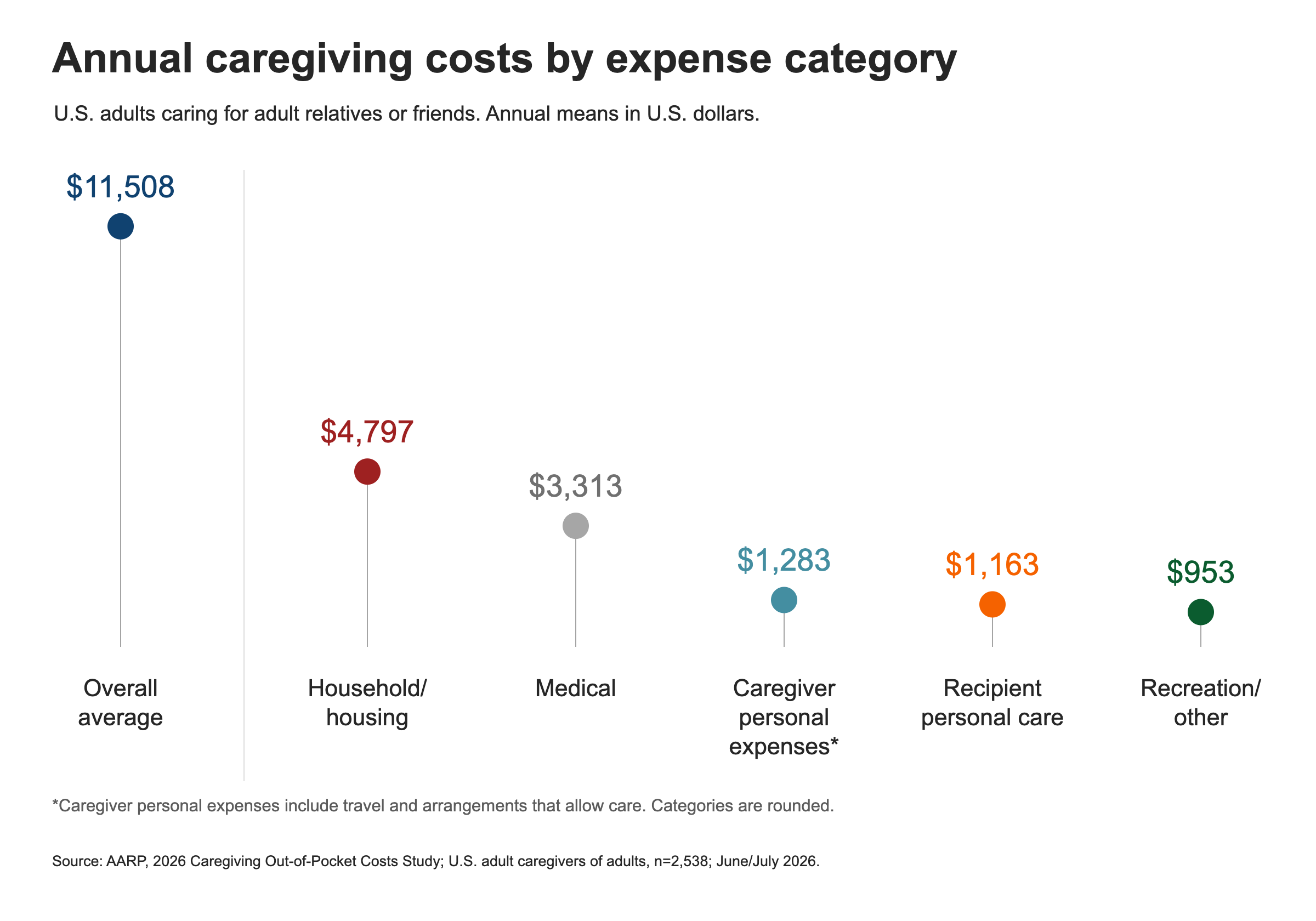
Groceries, housing support and travel can sit in different budget categories even when they serve the same care commitment. Asking only about medical bills can leave the conversation too narrow.
An advisor might begin with a question about the person being supported, then work through what the client covers. Which payments recur? Which were one-time purchases? Does the client pay a provider directly, send money to a relative or expect reimbursement from someone else?
The aim is a current estimate the client can explain. Keep the client's own living expenses separate, and check whether a shared household bill already includes the amount being discussed. Count each payment once.
The study's average is a reason to ask better questions. It cannot price an individual family's arrangement. Care needs, living situations and who shares the cost differ. An advisor needs the client's actual spending and uncertainty around it before deciding which planning assumptions deserve another look.
A change at work needs its own line in the review
An expense total cannot show the income a client has forgone.
In AARP's study, nearly two-thirds of the 1,737 working caregivers reported at least one of six work-related impacts. These included leave and working fewer, more or different hours, as well as an additional job. The finding describes several responses to care responsibilities, rather than a uniform loss of earnings.1
The advisor's questions should leave room for that range. Has the client changed their hours? Has take-home pay changed? Are they using paid leave, taking unpaid time or doing extra work to cover expenses? Is the current arrangement temporary, or is its duration still unclear?
A client who has changed shifts may have the same pay. A client who has reduced hours may have less income. Someone taking extra work may be covering the bills while questioning whether the schedule is sustainable. Those situations need different inputs in a financial review.
Where work has changed, identify what needs checking. Current earnings may be clear while the effect on employer contributions or benefits needs a separate check. An employer's rules and the client's circumstances determine those answers. Record what is known and who will verify the rest.
Ask what is paying for the care
A payment can look affordable in the monthly budget while drawing down money assigned to another goal.
EBRI and Greenwald Research reported in their 2026 Retirement Confidence Survey findings that 20% of caregiving workers had taken on new or additional debt as a result of caregiving. Their definition covers unpaid care for adults and/or children who need help with daily activities, so this is a different population from AARP's adult-care study.2
Ask where the money comes from. Current earnings, cash reserves, borrowing and lower saving each create a different discussion. Has the client changed a regular contribution or used money previously intended for another purpose?
Keep the accounting clear. If a withdrawal from savings pays a care bill, the withdrawal is its funding source. Adding both amounts to an expense total would count the same spending twice. The separate planning issue is what remains in savings and whether the earlier goal still rests on the same assumptions.
This does not make family support a mistake. A client may deliberately choose to direct money toward someone they love. The advisor's role in this conversation is to make the financial consequences explicit and understand which priorities the client wants the plan to reflect.
Financial strain is worth asking about directly
Financial Finesse's participant data add another perspective. In January through September 2026, 42.8% of elder or parent caregivers reported high or overwhelming financial stress, compared with 28.8% of participants with no dependents. These were initial assessments in an employer-program population, not a representative survey of all U.S. caregivers. They do not establish that caregiving alone caused the difference.3
An advisor should ask about the client's experience rather than assign it from a survey result. Which part of the arrangement feels hardest to sustain? Is the pressure coming from the amount, the unpredictability, the time involved or uncertainty about who will help next?
The client may know this month's expenses but have no agreement about future costs. Or they may have a workable financial arrangement and want the advisor to understand why a different goal now matters less.
Ask what the client wants help examining. A financial review can clarify the trade-offs without treating a conversation about stress as a diagnosis or assuming the client wants to reduce their care commitment.
Canadian evidence points to a similar planning question
Canadian advisors have relevant local evidence, with a different date and definition. Statistics Canada's analysis of 2022 survey data found that 35% of sandwich caregivers reported financial hardship because of their caregiving responsibilities. Here, sandwich caregivers provided unpaid care to both children and care-dependent adults or youth.4
These are historical, pandemic-era findings published in 2024. They cannot be directly compared with the newer U.S. expense and stress figures. Canadian care arrangements, employment benefits and public supports also need their own review.
The practical question remains useful. What does this client cover, what has changed in their working life and what have they postponed to sustain the arrangement? Use the household's actual Canadian circumstances to answer it. Questions about a particular benefit, tax treatment or legal authority belong with the appropriate professional and current rules.
Leave with a clearer commitment and a reason to revisit it
A useful review should leave the advisor and client able to describe the current care commitment in plain language. Record the recurring expenses and unusual costs, the funding sources and any change in earnings or saving. Mark estimates as estimates.
Then identify the unanswered questions. Is another family member expected to contribute? Does the client know when reimbursement will arrive? Which costs might change if the person receiving care moves or needs a different level of support?
Separate an agreed contribution from one the client merely hopes will happen. The same distinction applies to duration. A short-term arrangement needs a review date; an open-ended one needs a clear record of what remains uncertain.
The conversation should also establish what would bring the plan back for review. A change in work hours, a new recurring bill or a change in who shares the cost may be enough. Agree on which changes the client will raise and what information would help the next discussion.
Keep the scope clear when involving others. Confirm what the client permits the firm to discuss or obtain. Supporting a relative does not by itself settle permission to access that relative's accounts or make decisions for them.
The advisor may leave without knowing how long care will last. They should know what the client currently pays, how they fund it, what has changed at work and which questions still need answers.
Footnotes
-
AARP Research, 2026 AARP Caregiving Out-of-Pocket Costs Study, October 2026, pages 10, 11, 35 and 39. U.S. adult caregivers of adults; dollar amounts are U.S. dollars. ↩ ↩2
-
Craig Copeland and Lisa Greenwald, Caregivers and Retirement: Findings From the 2026 Retirement Confidence Survey, EBRI, July 22, 2026, research summary. ↩
-
Financial Finesse Financial Wellness Think Tank, The Caregiver Squeeze, October 30, 2026, section 2 and methods. The January to September 2026 sample includes 30,630 participants across all caregiving groups. ↩
-
Dana Wray, Statistics Canada, Sandwiched between unpaid care for children and care-dependent adults: A gender-based study, April 2, 2024, using Canadian Social Survey data from 2022. ↩