Imagine a meeting summary that changes one small detail. The client said they wanted to discuss helping a child buy a home. The AI-generated follow-up says they agreed to provide the money.
The draft reads smoothly. It came from a tool the firm approved. A colleague prepares to send it, assuming the advisor has checked the substance. The advisor assumes the colleague is still reviewing it.
Nobody intended to make a commitment on the client's behalf. The problem sits between the draft and the send button.
The Financial Stability Board's October 15 release of responsible-AI practices offers a timely reason to examine that gap.1
Decide what approval actually covers
Approving a tool answers whether the firm permits its use under specified conditions. It does not, by itself, tell the next person whether a particular summary is accurate, complete or ready for a client.
A useful starting point is to name the task. "Using AI" is too broad. Preparing an internal meeting outline, drafting a client email and changing a client record are different activities. Each has a destination, a person relying on the result and a consequence if something is wrong.
The FSB's framework emphasizes clear responsibilities and oversight suited to the risk of the use case. Its practices are a voluntary toolkit, not a new binding international standard or a substitute for applicable local requirements.2
Recent financial-planning research makes the operational question concrete. Among 4,270 respondents to a question about the contents of their firm's AI policy or guidance, 48% selected human review before outputs reach clients. The FPSB survey covered planners across multiple territories; this is reported policy coverage, not an audit of whether reviews happen or work well.3
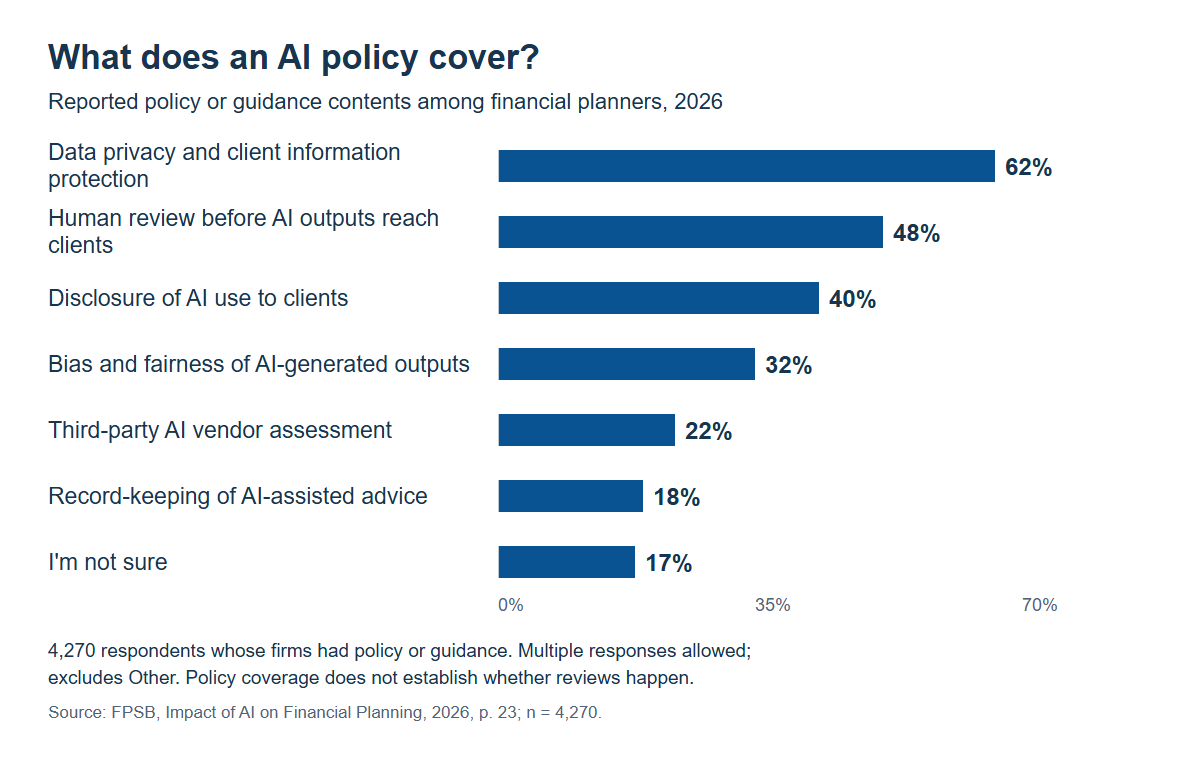
For a firm examining its own process, the more useful question is specific: who owns this draft between creation and release?
Give the reviewer something to check against
"Please review" leaves too much room for interpretation. One person may check tone and spelling. Another may check figures. Neither may notice that a tentative idea became an agreed action.
For the illustrative home-purchase conversation, the reviewer needs the underlying notes or other approved source material. The task is to establish what the client actually said, what remains uncertain and what the firm has undertaken to do.
A practical review could ask:
- Does the draft distinguish a question from a decision?
- Are names, figures, dates and responsibilities supported by the source?
- Has it omitted a condition that changes the meaning?
- Does it introduce an explanation or recommendation that was never discussed?
These are suggested checks for this kind of summary, rather than a complete supervisory checklist.
Source material can also be incomplete. An unclear note cannot support a confident statement simply because an AI system has turned it into a polished sentence. The reviewer may need to ask the advisor, verify the detail through the firm's process or leave the issue unresolved.
That is a useful outcome of review. A draft does not need to become sendable just because someone has spent time producing it.
Name who can release the work
A review step needs an owner with enough context to do the work. A client-service colleague might confirm scheduling details, while the advisor resolves what a planning discussion meant. The firm's procedures determine who may approve and send the final communication.
The handoff should make those responsibilities visible. If the reviewer identifies an unsupported commitment, someone must decide whether to revise it, seek clarification or hold the message. "Checked" is an unhelpful status when nobody knows what was checked.
The same person may perform several roles in a small practice. Separating the decisions still helps: preparing a draft, checking its substance and deciding that it can be used are distinct judgments, even when one person makes them.
Review effort should also reflect consequences. An internal outline that will be checked during preparation is different from a client-facing statement someone may act on. The FSB explicitly connects oversight to factors including risk, autonomy and complexity.2
This does not mean adding identical approval steps to every use of AI. An elaborate process can become a queue of rushed clicks. The aim is to make the important decision explicit and give the responsible person the evidence, time and authority to make it.
A useful rehearsal is to follow one draft through the actual process. Can each person explain what they received, what they checked and what the next person is entitled to assume?
Make corrections part of the workflow
Now suppose the mistaken commitment has already been sent. Editing the internal draft does not resolve what the client received.
The firm needs a way to identify the affected version, assess the significance of the error and assign the appropriate response under its procedures. That may involve the advisor, operations or compliance, depending on the content and circumstances.
For an internal handoff, a concise record could identify the source used, the person who reviewed it, the final version and any unresolved issue. Firms should determine what belongs in their approved systems and how it is retained. Keeping extra copies of sensitive information everywhere is not a substitute for a defined record.
Repeated corrections are worth examining together. If summaries keep turning possibilities into decisions, the team has a specific pattern to investigate. It might concern the source notes, the instructions, the tool's behavior or the way reviewers interpret their task. A one-off wording fix will not reveal which.
The practical test is modest. Take one AI-assisted client summary and trace it from source to final communication. Identify the person who can stop it, the evidence they use and who handles a correction.
If those answers depend on assumptions about what a colleague probably did, the review process needs more definition. The approved tool can produce the draft. The firm still has to decide when that draft deserves to be used.
Footnotes
-
Financial Stability Board, Final responsible-AI practices announced, October 15, 2026. ↩
-
Financial Stability Board, Sound Practices for Responsible Adoption of Artificial Intelligence: Final report, October 15, 2026, executive summary and practices 2 and 10. Voluntary, proportionate toolkit; accessed October 17, 2026. ↩ ↩2
-
FPSB, Impact of AI on Financial Planning: Global Research Report 2026, printed page 23. This multiple-response question concerned respondents whose firms had policy or guidance; n = 4,270, excluding Other. Overall survey fieldwork ran May 22 to July 6, 2026, with 8,095 planners across 37 territories. ↩