Imagine a client who has been talking about a trip for years. You have included it in the retirement plan and reviewed the assumptions together. At the next meeting, the trip is still unbooked.
The client wants to wait another year. When you ask why, they say they are worried about spending the money.
A possible care expense or family commitment could make the client question an earlier decision. They may feel uncomfortable using savings they spent decades building. Or the trip may matter less to them than keeping the money available.
Each answer calls for different work. Before revisiting the estimates, ask what the client believes spending would put at risk.
Spending confidence is a separate question
A retirement plan estimates how future income and savings could cover the household's spending. Those estimates depend on assumptions about costs, returns, and how long the money must last. The client may understand the calculation and still feel uneasy about a withdrawal. They also have to decide whether the purchase matters enough to them.
Prudential's October 2026 Retirement Pulse research illustrates the discomfort. In its survey, 86% of respondents reported that they did not feel free to spend their savings on things they enjoyed. The online study included 3,023 U.S. adults aged 50 and older, both retirees and pre-retirees, and ran from July 27 to August 2. Prudential, an insurer that sells retirement-income products, sponsored the research.1
The survey describes how respondents felt. It did not assess whether their finances could support more spending or test which response would help an individual client.
After discussing affordability, ask what still feels uncomfortable about the decision.
Caution can protect something the client values
Retaining savings can have a purpose. A research review by Eric French, John Bailey Jones, and Rory McGee identifies uncertainty about lifespan and medical costs, a desire to leave an inheritance, and the value of remaining in one's home as reasons households may retain wealth in retirement. The researchers also note that the relative importance of these motives remains unsettled.2
A client concerned about a surviving spouse or future care may be pointing to an expense or risk that needs closer analysis. Assuming they just need encouragement could leave that concern unanswered.
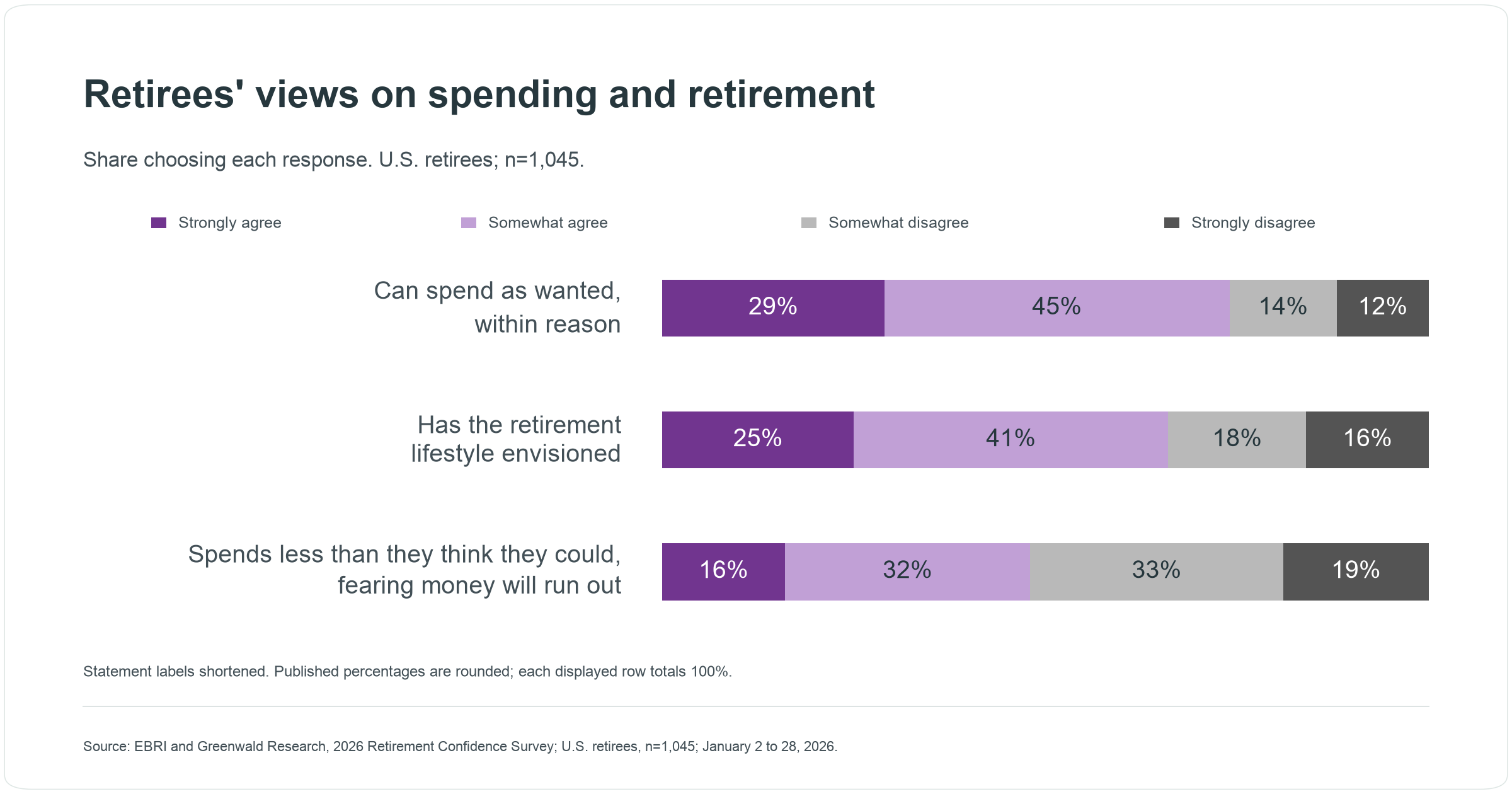
Other research shows why the conversation needs room for different experiences. The Employee Benefit Research Institute, known as EBRI, and Greenwald Research conduct the Retirement Confidence Survey. In its 2026 general-population sample, about three quarters of the 1,045 retirees agreed that they could spend money how they wanted within reason.3
That question differs from Prudential's question about feeling free to use savings for enjoyment. The studies surveyed different groups in different months. Their results are not competing measures of the same experience.
Ask what the client thinks the money is for
The same account may hold money for daily living, a possible gift, or a partner's future needs. The client may be trying to preserve something the plan has not made explicit.
The advisor can ask questions such as:
- What would you worry about being unable to do if you spent this amount?
- Is there an expense or responsibility we have not included?
- What would you prefer to keep this money available for?
- Has the thing you wanted to spend it on become less important?
In the imagined review, a concern about helping an adult child needs a different follow-up from discomfort at a falling balance. Ask what help the child might need, or what the lower balance seems to threaten.
The client's wishes may have changed too. Shorter visits with family might now appeal more than the journey they once imagined. Before working through the cost again, check whether they still want the trip.
The answer may remain incomplete. Recording that uncertainty is more useful than assigning a motive the client has not expressed.
Bring the worry back to a specific decision
Once the concern has a name, identify what the client needs to understand before deciding about the expense.
For the trip, clarify the timing, likely cost, and any continuing commitments it could create. If the client has raised a possible family expense, examine how that responsibility fits the plan. Having enough money overall and having cash available when a bill arrives are different questions.
Keep the uncertainty visible. A projection relies on assumptions about future circumstances. It cannot promise that care costs, markets, or household needs will unfold as expected. The useful discussion concerns what the plan includes, what it leaves unresolved, and what information could change the assessment.
Retraite Quebec's public education encourages people to examine changing expenses, housing choices, debts, and unexpected costs when preparing a retirement budget.4 Those subjects can help make a vague concern specific. Apply the rules and arrangements relevant to the client.
U.S. survey findings should not stand in for Canadian pension, tax, or care-cost analysis. Those questions require their own facts and professional judgment.
Avoid turning the discussion into a general instruction to spend more. The immediate result may be an updated estimate, a question for another professional, or a decision to wait until a responsibility becomes clearer. A client can also conclude that they understand the trade-off and want to proceed. The advisor still needs to review the recommendation and confirm the client's instructions before acting.
Let the client keep a different goal
Sometimes the money is already doing what the client wants it to do. Keeping it available may matter more than the purchase under discussion.
An advisor can explore that preference without making a larger lifestyle budget the measure of success. What is the client trying to preserve? What are they comfortable postponing or giving up? Under what circumstances would they want to reconsider?
An inheritance goal deserves the same care as a travel goal. The conversation should make its meaning and trade-offs clear. It should also establish whether the preference belongs to one person or reflects a shared household view. Agreement about an account balance does not establish agreement about how to use it.
The client may decide to take a smaller trip or keep the money for family support. Understanding why they chose gives the advisor something specific to review. Explain the implications and leave the priorities with the client.
Leave a record the next review can use
A note that says the client was reassured leaves little to return to. A more useful record identifies what they were concerned about and what remains to be examined.
In this example, a brief note could say that the client still wants the trip but first needs to understand how supporting an adult child would affect the plan. Name who will gather the missing information and when the discussion will resume. Considering an expense, deciding to incur it, and authorizing a transaction should remain distinct in the record.
That record gives the next conversation a starting point. If circumstances change, the advisor can revisit the concern that mattered instead of repeating a general assurance about the plan.
At the next review, return to what the client wanted to protect. Has the family responsibility become clearer? Does the plan need to change? Does the client still want the trip?
The booking may remain on hold. If the client can explain why, and the advisor knows what still needs checking, the conversation has moved forward.
This article is general education for wealth-management professionals. Its survey findings concern U.S. respondents. It does not assess any individual's spending capacity or provide investment, tax, legal, or medical advice.
Footnotes
-
Prudential Financial, 2026 Retirement Pulse release, October 1, 2026. Issuer-attributed release and survey methods. ↩
-
Eric French, John Bailey Jones, and Rory McGee, Savings After Retirement, December 2022. The review discusses research on precautionary savings, inheritance goals, and housing. ↩
-
EBRI and Greenwald Research, 2026 Retirement Confidence Survey, Figure 19, page 28. Fieldwork took place in January 2026. The retiree sample and question differ from Prudential's. ↩
-
Retraite Quebec, How can you manage your expenses in retirement?, accessed October 28, 2026. ↩