Imagine a client checking a stock price after dinner. A company has released news, the quote has moved, and the trading app appears to accept an order. The client asks a reasonable question: if I can trade now, what is different?
For an advisor, that question deserves more than a warning about volatility. It calls for an explanation of the session the client can access, what the displayed price means, and what happens after an order is submitted.
On October 8, 2026, the Canadian Investment Regulatory Organization published guidance and investor education on extended-hours trading. The announcement offers a useful reason to revisit those conversations before a client encounters an unfamiliar trading experience.1
Start with the session, not the clock
CIRO describes core trading hours as 9:30 a.m. to 4 p.m. Eastern Time. Its guidance applies to Dealer Members that facilitate client orders outside that window. Dealers are not required to offer that access, and providing it does not remove their existing regulatory obligations.2
The practical starting point is therefore specific: which dealer, which security, and which trading session?
A client may use "after hours" to describe any activity after 4 p.m. That phrase alone does not tell the advisor how the order will behave. Nor does a platform accepting an instruction necessarily mean a trade can occur immediately.
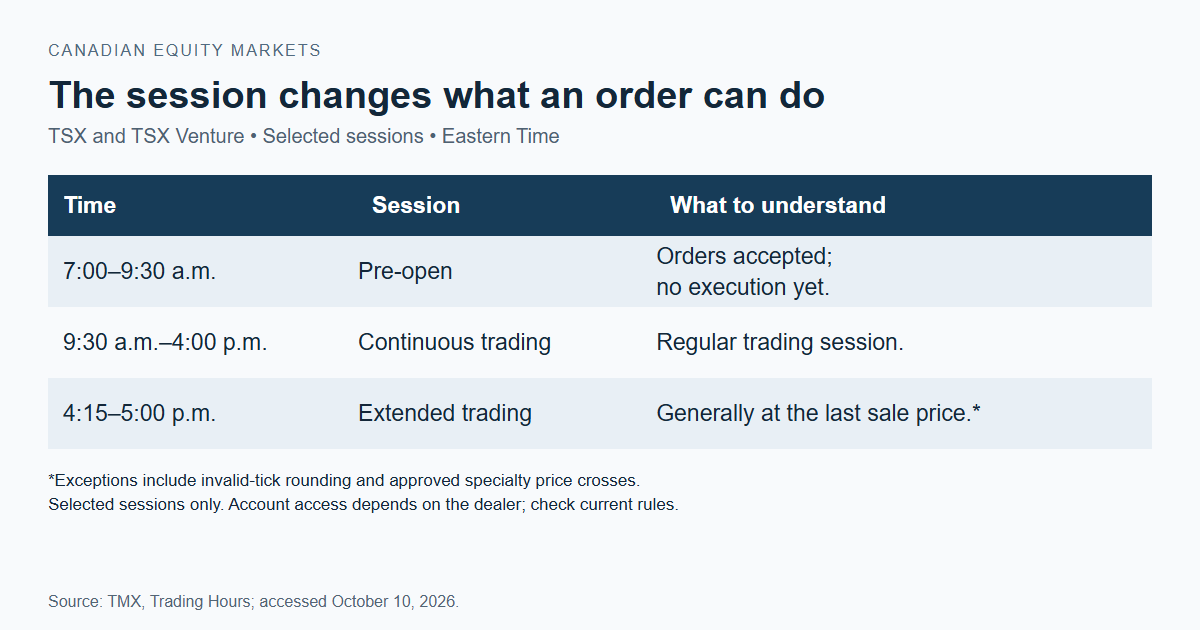
TMX's published schedule illustrates the distinction. The TSX and TSX Venture pre-open period accepts orders without executing them. Their extended session, from 4:15 p.m. to 5 p.m. ET, generally permits trades at the last sale price, with specified exceptions. That is different from simply continuing the regular session's trading process later into the evening.3
This example should help frame a question, rather than become a universal timetable. Confirm the client's actual access and the dealer's current documentation. A venue's published hours do not establish which sessions a particular account can use.
Explain what can change behind the quote
Liquidity describes how readily a security can be bought or sold. When fewer buyers and sellers participate, completing a trade at an acceptable price can become more difficult. CIRO identifies reduced liquidity, wider bid-ask spreads, and greater price volatility among the risks investors should understand.4
The bid is a price a buyer is offering. The ask is a price a seller is seeking. The difference is the spread. A client looking at one prominent number on a screen may not be looking at the price available for the trade they intend to make.
Ask the client what they are seeing: the last completed trade, a current bid, or a current ask. Then establish which session and marketplace that information represents. This keeps the explanation connected to the client's question instead of turning it into a lecture on market structure.
CIRO also cautions that extended-hours prices may differ between marketplaces and from the next regular session's prices. News released when trading activity is limited can have a greater effect on prices.2
The benefit deserves acknowledgment too. Additional sessions can give investors flexibility to respond outside the regular day.1 The advisor's task is to make the accompanying conditions understandable, without treating access as a reason to act.
Separate a price limit from a completed trade
Order terminology can create false reassurance. A client who understands that a limit order sets a price boundary may assume it also ensures the order will fill.
A buy limit order specifies the highest acceptable purchase price; a sell limit specifies the lowest acceptable sale price. Execution is not guaranteed. A market order, by contrast, does not guarantee the execution price. These are basic order mechanics, rather than a recommendation to use a particular order type.5
The useful conversation is about what the client expects to happen. Does the instruction apply to this session? What happens if only part of it fills? Does an unfilled order expire, or remain active under the dealer's terms?
Those questions should be answered from the relevant firm's instructions. Avoid carrying assumptions from one platform into another. An explanation that is correct for one account can still leave a client confused when another account uses different settings.
This is also a point to separate education from a trading decision. Explaining an order's mechanics does not establish whether the transaction fits the client's circumstances, or replace the firm's required process for the service being provided.
Make the service expectations explicit
The ability to submit an order and the availability of an advisor are separate questions. A client should know which channel to use for an urgent order issue, what assistance the dealer provides during the relevant session, and when the advisor is available.
A practical review can centre on four questions:
- Which securities and sessions can this account access?
- What prices and venues does the platform show or reach?
- How do order eligibility, expiry, and partial fills work?
- Who should the client contact if the order behaves unexpectedly?
CIRO's guidance addresses dealer disclosure about extended-hours access, marketplaces, order handling, and execution risks. These conversation prompts build on that guidance; they are not a substitute for the dealer's disclosures or a complete compliance checklist.2
Record the specific uncertainty raised, the explanation given, and any follow-up needed under the firm's process. "Discussed after-hours trading" says little about whether the client understood an unfilled order or a price that changed between sessions. A more precise note can make the next conversation easier to pick up.
The client who asks about trading after dinner needs a clear account of what their access actually permits. Once the session, price, order behaviour, and support arrangements are understood, the advisor can return to the client's underlying reason for asking.
Footnotes
-
CIRO, More Trading Hours, Different Risks, October 8, 2026. ↩ ↩2
-
CIRO, Guidance on Extended Hours Trading, GN-3100-26-001, October 8, 2026, sections 2–5 and 7. Canadian Dealer Member guidance; accessed October 10, 2026. ↩ ↩2 ↩3
-
TMX, Trading Hours, TSX and TSX Venture schedule, accessed October 10, 2026. Consult current venue rules and dealer availability. ↩
-
CIRO, Trading After the Market Closes: What Investors Need to Know, accessed October 10, 2026. ↩
-
SEC Investor.gov, Understanding Order Types. Used for general order mechanics only, not Canadian regulatory requirements; accessed October 10, 2026. ↩